Flawed Red Cliffs plan receives over 16,000 public comments
Dave Welz • January 13, 2020

The below is from a press release issued by our partners Conserve Southwest Utah, part of our Friends Grassroots Network. Additional coverage from The New York Times can be found here.


On January 8, Washington County residents, local and national groups marked the end of a one-month public comment period on the proposed Northern Corridor Highway. This 4-lane highway would travel through the heart of the Red Cliffs National Conservation Area (NCA) for approximately 5 miles, linking I-15 exit 13 to Red Hills Parkway. Utah Department of Transportation (UDOT’s) application for the right-of-way triggers 3 major plan amendments that would weaken protections for scenery, recreation, and threatened and endangered species on public lands in Utah.


Approximately 16,000 comments had been received on January 6th, with at least 2,000 more continuing to roll in. Conserve Southwest Utah is still adding up comments from Washington County residents and members of the 16 different local, regional and national coalition partners working together to defend Red Cliffs. Conserve Southwest Utah Public Lands Program Manager Sarah Thomas said that in all her conversations with partners, no one could think of a case where so many people commented on a scoping proposal:


“It’s amazing to have nearly 20,000 comments at this first stage in the National Environmental Policy Act (NEPA) process. Department of the Interior started the comment period for the most controversial public lands issue in Washington County history in the middle of the busy holiday season. We are very grateful to the huge number of people who carved out time from their Christmas and New Year celebrations to write to defend the Red Cliffs National Conservation Area.”


The Northern Corridor Highway has attracted high levels of local and national interest because the application for the right-of-way does the following: 


  1. Violates the promise agreed upon by Washington County government and citizens in 1995 to permanently protect the 62,000-acre Red Cliffs Desert Reserve in exchange for opening up over 350,000 acres of surrounding land for development.
  2. Fragments the popular T-bone and Cottontail trails and impacts 15 others.
  3. Destroys the exquisite scenery that attracts visitors and residents from across the country and around the world and exposes homeowners in Middleton and Green Springs to high levels of traffic noise, air pollution and litter.
  4. Threatens the integrity of the American system of National Conservation Lands, incredible places like Bears Ears and Grand Staircase-Escalante National Monuments; the Pacific Crest Trail and Iditarod National Trails; wild and scenic rivers and more.
  5. Jeopardizes the survival of the threatened Mojave desert tortoise in Utah. Red Cliffs NCA is home to the densest-population of threatened tortoise left surviving anywhere in its range, and this highway imperils their survival.
  6. It is the result of a rushed and closed-door process, opening up land for inappropriate development with little input from the public. 


This reckless application sets an unacceptable precedent for National Conservation Lands across the country. Utah’s public lands are world-renowned, and the law requires that they be managed on behalf of all Americans, including future generations.

Organizational quotes


Tom Butine, retired Aerospace Engineer and current volunteer Board President of Conserve Southwest Utah:

 “It took a massive effort over the holiday season to write scoping comments on the Northern Corridor Highway and associated plan amendments submitted yesterday on behalf of our 16-partner Red Cliffs Conservation Coalition and their members. This is the latest of 7 attempts by local government in the past 15 years to violate the 1995 Washington County Habitat Conservation Plan and the agreement to protect the Red Cliffs Desert Reserve (now National Conservation Area). The other attempts failed, and this one will too. There are transportation alternatives that could reduce traffic congestion without this unnecessary sacrifice of recreation, scenery and wildlife.”


Sarah Thomas, Public Lands Program Manager, Conserve Southwest Utah:

“I was 8 years old the first time I visited the Red Cliffs National Conservation Area. My dad took my brother and I to Babylon to walk beneath a sandstone arch, see dinosaur tracks and petroglyphs, and search for spiny soft-shelled turtles in the fine silt of the Virgin River. I was a teenager when I encountered my first threatened Mojave desert tortoise near the Hurricane Cinder Knolls. Like many other St. George residents, I mark big moments by going up on the Sugar Loaf to look out across the city, and then back, across a sea of red sandstone to the Pine Valley Mountains. Many of our favorite places are protected inside the Red Cliffs NCA. I want this land for my children someday, and I am thrilled to work with our community to protect Red Cliffs for the future.”


Howard Johnson, Warm Springs Resident:

“I have lived in Warm Springs for six years now. We moved here from California so we could have a nice retirement and get out of the smog. My wife has severe asthma so we needed a place with clean air. Building the Washington Parkway Extension behind our house in Warm Springs to that it can link up with the Northern Corridor Highway makes no sense. This new freeway would take away some of the scenery that people come up here to admire and cause noise, smog, congestion, and the building of more houses. Who would want to buy a home in this part of Washington county if the highway is built?”


Derrick Lytle, Filmmaker and Outdoorsman: 

"The Red Cliffs Desert Reserve/NCA is a jewel among jewels in Southern Utah. This special area is rich in cultural artifacts, natural beauty, and is a refuge from the chaos of life. The Northern Corridor is a short-sighted way to reduce traffic congestion while destroying the land that Utahans and visitors to the state hold sacred. A road through the Reserve is illegal and sets a precedence for the further destruction of protected public lands."


Lance Claymore, Screenwriter, Actor and Filmmaker:

“Red Cliffs is a place where we can get away from trucks blasting their engines from one stop light to the next. The land gives us a vacation from noise. Silence these days is a pleasure that many people no longer have. We need silence to be able think without influence from others and to rest our ears from the digital noise that constantly surrounds us. By protecting Red Cliffs, we protect this quiet for our future generations.”


Ichtaca Arrizon, Painter, Poet and Sculptor

“I go to Red Cliffs to find solitude and inspiration as an artist. It’s not just the scenery that makes Red Cliffs special, but the wildlife, too. This land is all that is left for ancient, sacred animals like the desert tortoise. We are guests on the land. How about we start to treat that which is around us with a little more dignity and respect? BLM should study transportation alternatives outside the red Cliffs NCA.”

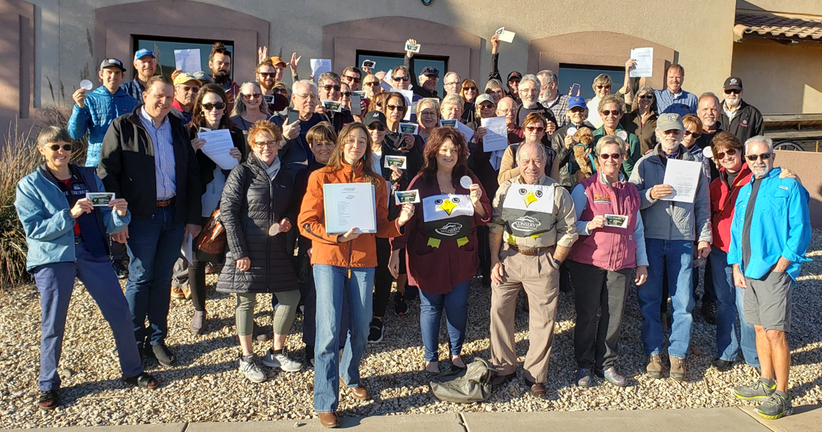
Above: Over 40 Washington County residents gather
at the local BLM office to submit scoping comments
on the Northern Corridor Highway.

By Maria Gonzales December 10, 2025
Some of my earliest and most formative memories are on public lands in New Mexico, where I grew up camping under impossibly starry skies, hiking rocky canyons, and exploring every sunbaked arroyo in Santa Fe for lizards and other small critters. Growing up in the Southwest made me deeply aware of both the beauty and the fragility of these landscapes. I saw how fire, drought, and mismanagement could threaten not only ecosystems, but the health and well-being of the communities who depend on them. Those experiences shaped me. They taught me that caring for wild landscapes isn’t passive, it’s a collective responsibility. That belief has guided my career and approach to leadership: philanthropy is fundamentally about stewardship, community, and creating the conditions for impact to scale. It’s also what drew me to the Conservation Lands Foundation. Its clarity of mission, its commitment to community-led conservation, and its track record of protecting and expanding the National Conservation Lands represent the future of protecting nature, one rooted in collaboration, shared power, and long-term investment. 
Congress building
By Conservation Lands Foundation December 2, 2025
Washington, D.C. — The Senate Energy and Natural Resources Committee heard five conservation bills, which will enact much-needed new protections for public lands in Colorado, Nevada and New Mexico. Below is a statement from Chris Hill, CEO of the Conservation Lands Foundation, which represents a national network of community advocates who are solely focused on the public lands overseen by the Bureau of Land Management, including the National Conservation Lands: “We thank the champions in the Senate who introduced and continue to move forward these important bills that protect the public’s access to nature and essential wildlife habitats, while supporting Tribal culture and economies. It’s heartening to see the Senate advance meaningful public lands policy with the bipartisan support we know exists with their constituents. These bills include: S. 1005 Southern Nevada Economic Development and Conservation Act, sponsored by Senators Cortez Masto and Rosen of Nevada. S.764 Colorado Outdoor Recreation and Economy (CORE) Act, sponsored by Senators Bennet and Hickenlooper of Colorado. S. 1195 Pershing County Economic Development and Conservation Act, sponsored by Senator Rosen of Nevada. S. 1319 Pecos Watershed Withdrawal and S. 1476 M.H. Dutch Salmon Greater Gila Wild and Scenic River Act, both sponsored by Senators Heinrich and Luján of New Mexico. “These bills honor our collective commitments to strengthen our bonds with the lands we know and love and we urge the Senate Energy and Natural Resources Committee to ensure they are passed by the full Senate quickly.” ###
November 25, 2025
The holiday season is a time for gratitude for the people we love and the places that sustain us. This year, we invite you to celebrate by giving gifts that protect the public lands and waters we all treasure. Whether you're shopping for the outdoor enthusiast in your life or simply looking for a meaningful way to give, here are ways your generosity can help defend and protect nature.
November 25, 2025
Today, the future of public lands — our wildlife, water, and way of life — is under threat like never before. But, as with any darkness, there is always light, and that light shines through the people, organizations, and coalitions working with us to ensure clean water, healthy habitats, diverse wildlife, and thriving local economies. We believe deeply in the power of the people and the people are on our side. Your partnership powers real solutions. Our 2025 Impact Report shows what we were able to accomplish together. Click the image or button below to read our report.
mountains and forest
By Conservation Lands Foundation November 21, 2025
Patagonia, Adyen ask customers to protect public lands this holiday season
November 19, 2025
Washington — Six organizations sent a letter to the Acting Director of the Bureau of Land Management (BLM), warning that at least 5,033 oil and gas leases — covering nearly 4 million acres — may now be legally invalid. The letter asks the agency to halt all new leasing and permitting until it “ensure[s] compliance with the law and remed[ies] this grave legal uncertainty.” Ultimately, Congress must fix the legal crisis it created. The letter details how Congress' unprecedented use of the Congressional Review Act (CRA) to overturn BLM Resource Management Plans (RMPs) has called into question the legal efficacy of every land management plan finalized since 1996. These plans don't just guide management decisions; they enable everything that happens on public lands, from oil and gas drilling to recreation, grazing, and wildlife protection. If land use plans may now be invalid, then thousands of oil and gas leases and drilling permits issued under them may also be invalid Congress Was Warned About CRA Consequences When Republican members of Congress voted in October to use the CRA to overturn three RMPs in Alaska, Montana, and North Dakota, they ignored urgent warnings from conservationists, legal scholars, former BLM officials, and even some energy industry voices about the chaos this would unleash. The agency's own Solicitor’s Office cautioned that treating RMPs as “rules” could call into question the validity of every BLM plan since 1996 — along with the leases, grazing permits, rights-of-way, and other decisions based on those plans. Thirty leading law professors warned that this move could jeopardize “thousands of leases and management decisions across hundreds of millions of acres.” Former BLM leaders said overturning land-use plans under the CRA would “undermine the basis for authorizations” and create widespread legal uncertainty for energy developers, ranchers, and recreation permittees, threatening the integrity of the entire planning system. But Congress ignored these warnings — and is now moving ahead with even more CRA resolutions that will escalate the crisis. "By incorrectly treating land use plans as rules under the Congressional Review Act, Congress hasn't just overturned three plans — they've thrown every plan finalized since 1996, representing 166 million acres, into doubt. That mistake replaces a stable, science-based, community-driven system with needless chaos and uncertainty. It was lazy and irresponsible and is harmful to all land users," said Jocelyn Torres, chief conservation officer at the Conservation Lands Foundation. Along with the at least 5,033 existing leases, the legal uncertainty extends to future leasing. According to the letter, 69.8% of all BLM lands available for oil and gas leasing are managed under RMPs finalized after 1996 that were never submitted to Congress. BLM is currently evaluating 850 parcels totaling 787,927 acres across 14 upcoming lease sales on lands that may lack a valid RMP. This legal chaos affects far more than oil and gas. Land management plans for national forests, national parks, and national wildlife refuges finalized since 1996 may also be invalid, potentially calling into question grazing permits, timber sales, recreation authorizations, and wildfire management projects across hundreds of millions of acres nationwide. "Congress was warned repeatedly that weaponizing the CRA against land management plans would create exactly this kind of chaos. They charged ahead anyway, putting short-term political gain ahead of stable land management. Now they've jeopardized the very oil and gas development they claimed to be protecting. Congress must immediately fix the mess it made." said Alison Flint, senior legal director for The Wilderness Society . “Let’s be crystal clear: The Congressional Review Act is bad public policy. And it’s absolutely terrible public policy when used to overturn comprehensive public land planning decisions that radically reduces predictability for all public land users — in particular, as we have highlighted to the Bureau of Land Management, the oil and gas industry itself,” said Melissa Hornbein, senior attorney at the Western Environmental Law Center. “Congress lit the fuse on a legal time bomb that now calls into question the validity of thousands of oil and gas leases covering millions of acres as well as grazing permits and numerous other authorizations. But equally concerning, use of the CRA unravels decades of community-led land-use planning and throws into disarray the legal foundation for how our public lands are managed,” said Laird Lucas, executive director at Advocates for the West. “Congress’s use of the CRA to disapprove several Bureau of Land Management land use plans that were put in place following years of stakeholder and Tribal Nation input has sown confusion throughout the American West. This is not what Congress intended when it passed the CRA,” said Steve Bloch, legal director for the Southern Utah Wilderness Alliance. “As one of the principal architects of this newest line of attack on public lands, Sen. Daines opened Pandora’s Box. Using the Congressional Review Act to wipe out years of local work on Resource Management Plans is unprecedented, and it puts rural economies at risk, including the oil and gas industry. Inserting Congress into these processes threatens to unravel the foundations of public resource management and dismantle the systems that communities, businesses, and Montanans rely on. Congress is heading down a reckless path, yet another example of the pattern of attacks we’re seeing out of Washington D.C. on one of the most foundational aspects of Montana’s way of life: our public lands and resources,” said Aubrey Bertram, Staff Attorney & Federal Policy Director at Wild Montana.
Congress with text
November 19, 2025
Washington, D.C. — The U.S. House last night used the Congressional Review Act to consider and pass three resolutions undermining public lands protections in three areas in Alaska and Wyoming. The three resolutions are: S.J. Res. 80 – disapproving of the ‘‘National Petroleum Reserve in Alaska Integrated Activity Plan Record of Decision’’. H.J. Res. 130 – disapproving of the ‘‘Buffalo Field Office Record of Decision and Approved Resource Management Plan Amendment’’. H.J. Res. 131 – disapproving of the ‘‘Coastal Plain Oil and Gas Leasing Program Record of Decision’’. Below is a statement from Jocelyn Torres, Chief Conservation Officer of the Conservation Lands Foundation, which represents a national network of community advocates who are solely focused on the public lands overseen by the Bureau of Land Management (BLM), including the National Conservation Lands: “Today’s action by the U.S. House is part of a series of coordinated attempts to roll back common sense management of public lands. It’s simple - America’s public lands should be managed for the public good. These resolutions undermine the U.S. Bureau of Land Management’s authority to manage public lands for the benefit of all Americans, not just those who seek to buy up and close public lands to public access and benefit. “It is clear from the recent actions of this Congress to remove protections from key areas across the West that supporters of these actions are opponents of public lands. By removing the BLM’s authority to manage lands, these resolutions ensure that privatizing or industrializing them are the only viable remaining options. It’s a classic example of trying to solve a problem that was self-inflicted for the express purpose of achieving an outcome that benefits you. “We remain opposed to these one-sided, destructive attempts to roll back the clock on public lands protection and we’ll continue to work with members of the Friends Grassroots Network to oppose these obvious attempts to use public resources for private gain. We’ll continue to remind members of Congress that the overwhelming majority of Americans support responsible, effective, balanced management of the public lands.” ###
November 17, 2025
Rule repeal leaves irreplaceable wildlife habitat vulnerable to unchecked oil drilling, despite 300,000+ public comments in support of conservation
November 10, 2025
Members of Congress, local elected officials, Tribal leaders, outdoor industry executives, legal scholars and former BLM officials join calls for protecting public lands and preserving the Public Lands Rule.
Press Statement and Congress building
By Conservation Lands Foundation November 6, 2025
Oil Ties and Land-Sale Stance of Nominee for the Country’s Largest Public Lands Manager Threatens Local Communities and Agency’s 'Multiple-Use' Mandate
Show More